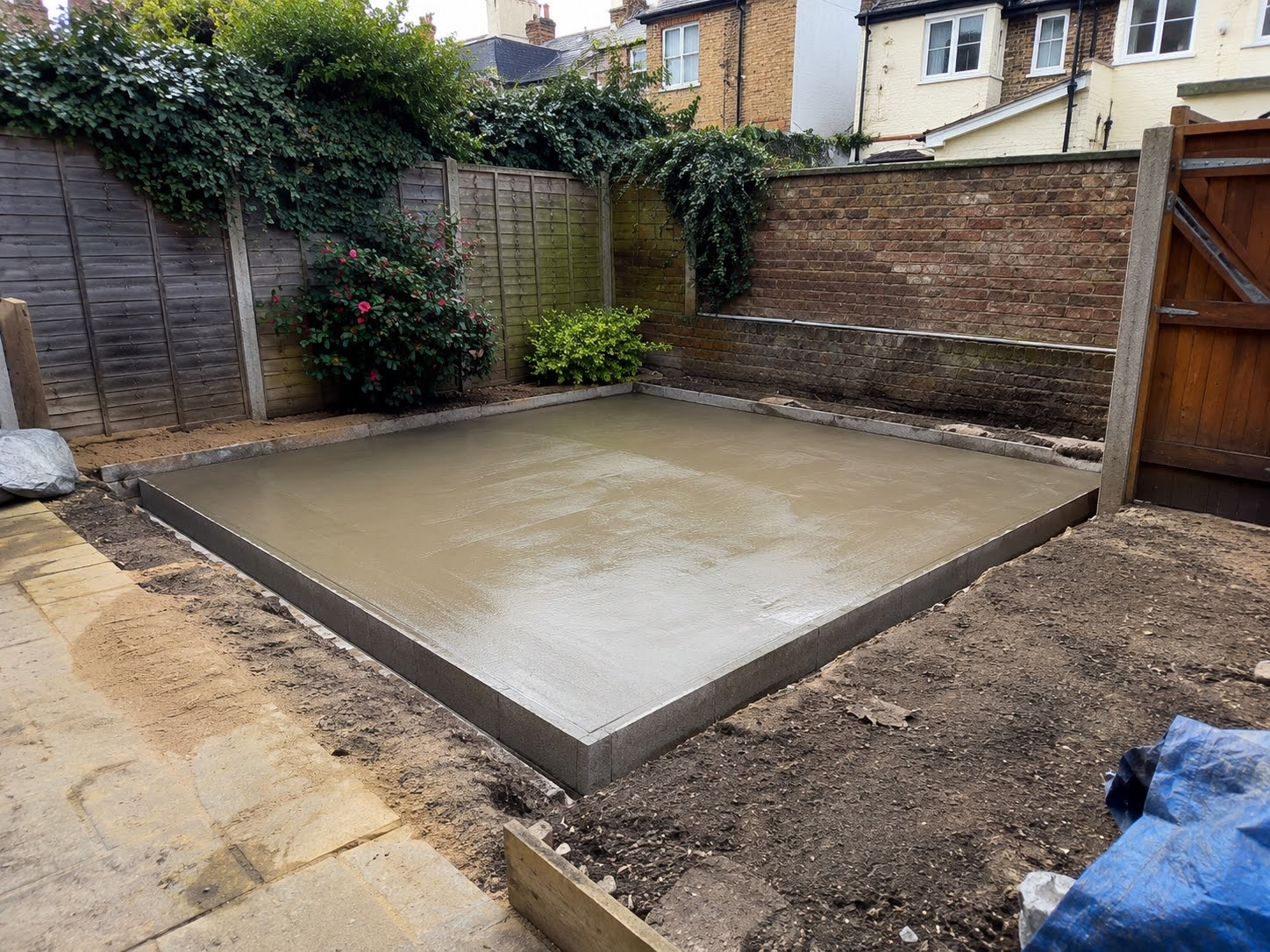
What Makes a Base Level and Stable?
A properly built concrete shed base in Enfield is not just about pouring concrete. Stability comes from preparation, depth, compaction, drainage, and how the slab is finished and cured. If any part of that process is rushed or skipped, the base can move, crack, or hold water — and that affects the shed sitting on top of it.
This guide explains what actually makes a concrete shed base level and stable, what homeowners in Enfield should expect during installation, and how long-term performance is achieved.
What keeps a concrete shed base level?
A level, stable concrete shed base is created by combining proper excavation, a compacted sub-base, controlled concrete supply, reinforcement where needed, correct finishing, and suitable curing time. In Enfield, local soil conditions, drainage behaviour, and garden access all affect how that process is carried out.
The base must sit on ground that will not move. That means removing soft soil, installing a stable foundation layer, ensuring water can escape, and checking levels before and during the pour. Once concrete is placed, it must be finished flat and left to cure correctly so it reaches its designed strength.
When homeowners search for a garden shed base in Enfield, they often focus on the surface. In reality, the stability comes from what sits underneath and how the slab is formed from start to finish.
Timeline for a stable concrete shed base in Enfield
Most residential concrete shed base projects in Enfield follow a predictable timeline, even though the size and access can change from property to property. Understanding the sequence helps homeowners see why preparation matters as much as the pour itself.
First comes site setup and excavation. This is where turf, topsoil, and soft ground are removed to reach a firm layer. Next, a sub-base is installed and compacted to stop movement. After that, formwork and levels are set so the concrete has a defined shape and height.
The concrete is then delivered and poured, levelled, and finished. Once complete, the slab must cure before it can safely support a shed or structure. Although the pour itself might only take a short time, stability is built across the entire process.
In most Enfield gardens, the physical installation is completed in a day, but curing continues for several days after. Rushing this stage is one of the most common causes of uneven or damaged bases.
How a level concrete shed base is built
1. Excavation and ground preparation
Everything starts with excavation. Grass, organic material, and loose soil are removed until a firm, stable layer is reached. In Enfield, gardens can vary from clay-heavy soil to mixed ground, so depth is adjusted to ensure the base is not sitting on compressible material.
Skipping excavation leads to settlement later, which is why stable bases always begin below the surface you can see.
2. Sub-base installation and compaction
A sub-base, usually made from compactable aggregate, is installed next. This layer spreads load and prevents movement. It is compacted in stages so the concrete above does not sink or tilt over time.
Without compaction, even thick concrete can move as the soil beneath shifts.
3. Formwork and level control
Timber formwork sets the edges and final height of the slab. Levels are checked so the base is flat and slightly designed to manage surface water. In Enfield gardens, this also considers nearby walls, fences, and access points.
4. Concrete supply and pouring
Concrete is delivered from local batching plants and mixed to suit residential slab work. The mix must be consistent so the slab cures evenly. During the pour, the concrete is spread, tamped, and levelled so no low points remain.
5. Finishing and curing
Once poured, the surface is finished smooth and flat. The slab is then left to cure. Curing allows the concrete to gain strength gradually rather than drying too fast, which can cause cracking or weakness.
Stability is not just about how it looks on day one — it is about how it behaves months and years later.
What affects stability in Enfield gardens?
Not all Enfield properties are the same. Several factors influence whether a concrete shed base remains level long-term.
Soil type plays a role. Clay-heavy areas can hold water and expand, while sandy areas may drain faster but need stronger compaction. Drainage is another major factor. If water cannot escape, it sits under the slab and weakens the support.
Access also matters. Many Enfield homes have side passages or rear-only garden access. This affects how materials are delivered and how accurately the work can be carried out. Proper planning ensures equipment and concrete arrive when the base is ready.
Load is important too. A small storage shed and a heavy log cabin require different preparation. Stable bases are designed around what the slab will actually support.
How base size impacts level and strength
The size of your concrete shed base in Enfield changes how stability is achieved. Smaller bases are quicker to prepare, but still require proper depth and compaction. Larger bases need more careful planning so weight is distributed evenly.
Wider slabs often include reinforcement such as mesh to prevent cracking under load. Thickness is adjusted depending on the structure — a workshop or cabin base will usually need more support than a small tool shed.
A one-size-fits-all approach leads to movement over time. Stable bases are always designed around scale and intended use, not just surface area.
Enfield conditions that influence concrete bases
Enfield experiences seasonal weather changes that affect soil moisture and drainage. Winter rain and summer drying cycles can cause ground movement if a base is not supported properly.
Many Enfield properties also have nearby boundaries, older paving, or limited garden width. These factors affect excavation depth, edge support, and water runoff planning.
Homeowners should also be aware of general planning and building guidance for structures. Government guidance on permitted development and building work can be reviewed at gov.uk planning permission guidance.
Taking local layout and regulations into account prevents problems later and keeps installations compliant and functional.
When is a concrete shed base ready to use?
After installation, concrete does not instantly reach full strength. It gains strength gradually as it cures. Most Enfield shed bases can be lightly walked on within 24–48 hours, but heavier loads should wait longer.
For sheds and garden rooms, it is normally advised to wait several days before installing the structure. Full curing continues for weeks, but early patience prevents cracking and sinking.
Using a slab too soon places stress on concrete that has not yet hardened fully, which is one of the easiest ways to reduce long-term stability.
Concrete shed base questions
How thick should a concrete shed base be?
Thickness depends on what the base will support. Light sheds may need less depth, while cabins and workshops need thicker slabs with reinforcement for stability.
Why do some bases crack?
Cracking usually comes from poor preparation, fast drying, lack of reinforcement, or ground movement underneath the slab.
Can water affect my base?
Yes. Poor drainage allows water to collect under or on the slab, weakening support and encouraging movement over time.
Is local installation important?
Local Enfield knowledge helps account for soil, access, and scheduling so the base is installed under suitable conditions.
Concrete Shed Base Installation in Enfield
If you're planning a shed or garden structure, getting the base right makes all the difference to performance and lifespan.